
One of the common mistakes that I have (primarily) come across in email correspondence is the usage of the words “response” and “respond”. It happens so often that most people do not even realise they are making these mistakes. Getting this wrong in emails makes your writing look err… a little sloppy and unprofessional. While most people will likely understand what you mean, using the correct word shows attention to detail and strong communication skills.
Now, take a look at the following screenshots of actual emails (and a draft document) that I have received:
 Email Correspondence 1
 Email Correspondence 2
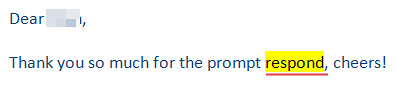 Email Correspondence 3
 Email Correspondence 4
 Email Correspondence 5
 Draft Document
The confusion that arises here is likely due to the fact that the writer does not know how to distinguish between which one is a verb and which one is a noun.
Response is a noun
A noun is used to describe almost everything that we can see or talk about, i.e., actions, animals, ideas/concepts, objects/things, people and places. The word “response” is a noun, and it is a reply or an answer to a question, or something that requires a response. It’s a thing you get back.
Respond is a verb
A verb is used to describe an action in a sentence. The word “respond” is a verb, and it refers to the action of replying or answering. So when you reply to an email, you are taking an action and that action is responding.
Here are the corrected versions of the above emails and draft document:
Email Correspondence 1
I will respond to your email when I am back then.
Email Correspondence 2
Dear all,
I am so sorry for not being able to respond to all of you earlier.
Email Correspondence 3
Dear John Doe,
Thank you so much for the prompt response. Cheers!
Email Correspondence 4
Team,
Please see my responses below…
Email Correspondence 5
Dear John Doe,
Response received from ITD. Please take note of the timetable below.
Draft Document
3. Be able to respond to emergency situations effectively.
More examples of “response vs. respond”
The following table summarises the two with more common scenarios that you will likely encounter in your work:
| Word | Response | Respond |
| Difference | Noun (the thing) | Verb (the action) |
| Meaning | A reply or an answer to a question, or something that requires a response. | The action of replying or answering. |
| Scenario | “I received a positive response from the IT team about the new product release date.”
“Thank you, Jane. Your response was thorough and helpful.” “We are waiting for their response before committing to a date.” |
“Can you respond to this by Friday 16th June?”
“John responded to the customer’s complaint within hours.” “I will respond to your enquiry once I have more information from the team.” |
Did this post clear things up for you? I hope so! Share this with your colleagues and friends. If you like this post, check out other similar ones like “Login Vs. Log in” and “Deadline Vs. Dateline”.


Which is correct if you want to thank someone for responding to your concern immediately?
“Thank you for your immediate response.” or “Thank you for your immediate respond”.
The first one :)
Hi wat is the right sentence.
Here is my respond to your email or Here is my response to your email?
Hi Devs, I don’t think it’s common to use such phrase when replying an email, but if you must, then “Here is my response to your email” would be more accurate than “Here is my respond to your email”
I am making a video slide, one of the slides have a short text, “prompt respond”. The slide image with a lady working in front of her laptop. Is the word, respond I use correct?
Hi Kenneth, I’m not sure if I understand you correctly. You’ll need to elaborate further. But “prompt respond” is not correct. “Prompt response” is.
Hello I’m usually not baffled but I’m making a program for an appreciation program, I have a “ welcome “ now I’m requesting a respond or a response? Please help!!!
Errr I don’t quite understand your uhm problem statement…but I guess it should be a ‘response’
Is it correct? “Text me for quick response”.
Thank you
Yes it is correct.
hello sir
if we sent massages to someone but he/she didn’t reply. but after some days he/she say hi. then what we should use that “i sent to urgent msg but i don’t get response/respond yet.”
which is right here?
I think response for noun.
What is the right sentence?
Hoping for you quick respond or response?
I am waiting for your quick respond.
Because, it is a verb.
“Response” because the verb in the sentence is waiting… what’s he waiting for? – a quick response :)…hope this helps :)
I mean “Hoping” is the verb…. Hoping for your quick response
Is it correct? “Thank you so much for your prompt response & action”.
The sentence is absolutely correct arising from the fact that prompt is verb in the sentence.
Merriam-Webster has respond as a noun
http://www.merriam-webster.com/dictionary/respond
Hey Duong,
Well, that’s true BUT…did you take a good look at the definition? ;)
which is correct? AWAITING RESPONDS OR AWAITING RESPONSE
Awaiting response :)
In a liturgy particular in psalm..how should I say it?response? Or respond?
What is right: ‘a response to’ or ‘a response on’?
Hi Aleksander,
It depends on your sentence. In general, “in response to” is normally used.
I have not received the respond yet or response yet.
Hi Prem,
It should be “I have not received the response yet”
Which of the sentences is correct? I response to your email or I responded to your email?
Hi Mavs,
It depends on the context and intention/purpose of your reply. For example, if you are asked whether you have replied to a person’s email, then you can say “I have responded to your email yesterday/earlier” if you have already replied. But if you have not, then you can say “I will respond to your email soon/on (a date).” You can also use the word “reply”, i.e., “I have replied to your email yesterday/earlier” or “I will reply to your email soon”
Hi Mavs, the statement should be RESPONDED because it reflect on action i.e. Adverb.